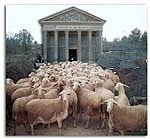
 This week, the United States Supreme Court covered itself with indelible, shame. It prostrated itself before the Imperial Executive's invocation of raison d'etat and denied judicial view to a German litigant who had sued the C.I.A. for kidnapping, false imprisonment and torture.
It would be unright to say that with "a stroke" the Supreme Court undid the very principle of legality upon which this country was founded. The Court was so utterly supine that its "act" of declining to hear an appeal from a lower court dismissal of the suit consisted in assuming a posture of complete judicial passivity and indifference to its own raison d'etre. A crown agent all but walked into the Atrium of Justice, pronounced two words and the court vanished itself like so much water receding into sand.
There was a time when every eighth grader understood that judicial review was the sole bulwark against the evil of secret state security courts like the dreaded Star Chamber. What made the Star Chamber infamous was not that it was irregular or arbitrary. On the contrary, like any inquisitorial court, the Chamber was governed by precise procedures designed to insure the reliability of its judgements. Except, that is, for those special procedures later embodied in the Fifth and Sixth amendments of the Bill of Rights which have been considered necessary to insure fundamental notions of fairness.
What procedures? Nothing more than the right against self-incrimination, the right to be informed of the charges, the right to confront and examine one’s accusers, the right to produce evidence in self-defense and the right to a speedy, full and fair hearing with the assistance of counsel in open court.
Why "fundamental"? Because the justness and necessity of these rights is either self-evident or it is not. These rights are "axiomatic" because they cannot be proved right or wrong. They comprise the Constitutional Faith on which this country was founded. There are arguments that can be made -- and that have been made even by certain Harvard and Yale professors -- in favor of secret proceedings, interrogations in the dark and torture. They are even "reasonable" arguments based practical calculations of risks and benefits. But, for all that, they are not "what we are about." And "what we are about" -- as a People of a certain political faith -- is reflected in the Bill of Rights and the principle of Judicial Review.
There was a time when every eighth grader had read the story of Lord Coke's confrontation with King James I when the Chief Justice approached the Throne and announced that the King himself was subject to the Law. James grew "mightily wroth" and moved to strike Coke who was ushered away. But it was a judicial shot across the bow of executive power. Three years later, in 1610, Coke handed down the decision in Dr. Bonham's Case. The problem in that case was that Bonham was not much of a doctor and had been tried, convicted and fined by the Royal College of Physicians for practicing without a license. Coke and two other judges ruled that the College could not act as a judge in a case in which it was also a party, even if Parliament had given it the "right" to do so. In rendering judgement, Coke announced that "the common law doth control Acts of Parliament, and sometimes adjudge them to be void ... as when an Act of Parliament is against Common right and reason, or repugnant...." By "the common law" Coke unmistakably meant the judiciary. As Chief Justice Marshall would put it near two hundred years later, in Marbury v Madison, "It is emphatically the province of the judiciary to say what the law is."
"What the law is..." is not a question of mere legality. After all, in Bonham's Case Parliament had passed a law authorizing his trial and conviction by the College of Physicians. But for Coke that was not enough because, in his view, that law was "against Common right and reason." To say as much was something of a judicial pun or feint of pen. Because it would have been logically nonesense to state that a law was illegal, Coke subordinated the common law to something higher -- to something he called "common reason". It is this subordination of legality to higher, concepts of due process, reason and fairness that is the foundation of Anlgo-American constitutionalism, and this subordination of law to reason necessarily entails an ultimate subordination of the Executive to the Judiciary.
Later in his career, after consistently making life difficult for his sovereign, Lord Coke went on to draft the Petition of Right one of a long line of English antecedents to the US Bill of Rights. Building on the principles announced in Magna Carta, Coke declared that all men -- not only Lords, Barons and Peers of the Realm -- had a right against arbitrary state actions and exactions. The petition declared unconstitutional certain actions of the king, such as levying taxes without consent, housing soldiers in homes, setting up martial law, and having men imprisoned, disinherited or put to death "without being brought to answer by due process of law."
Lord Coke's career illustrated that judicial review, constraint on executive power, constitutionalism and individual rights, are all strands in one seamless garment. Each implies the other and without any one the fabric unravels. Ultimately, these principles protect our right to breathe free and unshadowed by fear -- fear of unwarranted arrest, night-time detentions, renditions to dark and unknown places and torture. It was not for nothing that the bronze doors to the Supreme Court depict Lord Coke barring King James from sitting as a Judge.
Not for nothing? This week, a crown agent, in effect, pushed through these very doors and with two words -- "National Security" -- barred the Justices from sitting as Judges and denied a man the right to have his case heard in court. This was a case in which the United States Government violated every known principle of "due process" by abducting, imprisoning and torturing a man without even telling him why and on what basis it was subjecting him to such a nightmare. Like all tyrants, the Government condoned itself with the usual spew about safety and necessity. And hiding in their Mausoleum of Justice, Coke's wretched descendants did nothing. There will doubtlessly be those legal hacks who will try to explain away the Court's judicial decadence by blathering about "ripeness of issues" or the need to await the "appropriate vehicle" in the "correct procedural posture." Bullshit.
Tuesday October 9th was a funereal day for the little that was left of five hundred years of constitutionalism. Odious in the eyes of those who apprize liberty, the scum on the court have earned their place in the gutters of history.
©WCG, 2007