Tuesday, October 23, 2007

The Struggle for Perfect Security


Homeland Security Leader, Michael Chertoff, has nullified a court ruling halting the construction of a border security fence until further environmental impact studies were completed. Chertoff's swift and summary executive aktion will be appreciated by those who value safety above all else and who have little patience for quibbling courts getting in the way of our National Security.

Ever quick to see the core issue and seize the highground, Chertoff explained that he was confident the lower court would ultimately have been overruled in any case and so was merely hurrying things up a little. Chertoff also told us that dirty Mexicans were strewing lots of environmentally degrading garbage in the area which was far worse than bulldozing the whole damn preserve and turning it into a clean if lifeless swatch of concrete.

Of course, what applies to environmental laws applies to any law and we can all rest secure in the knowledge that one man will decide what is best for us and will let nothing stand in the way of securing the nation as tight as the screw will bear.


©WCG, 2007

Friday, October 12, 2007

Supreme Shame.


This week, the United States Supreme Court covered itself with indelible, shame. It prostrated itself before the Imperial Executive's invocation of raison d'etat and denied judicial view to a German litigant who had sued the C.I.A. for kidnapping, false imprisonment and torture.

It would be unright to say that with "a stroke" the Supreme Court undid the very principle of legality upon which this country was founded. The Court was so utterly supine that its "act" of declining to hear an appeal from a lower court dismissal of the suit consisted in assuming a posture of complete judicial passivity and indifference to its own raison d'etre. A crown agent all but walked into the Atrium of Justice, pronounced two words and the court vanished itself like so much water receding into sand.

There was a time when every eighth grader understood that judicial review was the sole bulwark against the evil of secret state security courts like the dreaded Star Chamber. What made the Star Chamber infamous was not that it was irregular or arbitrary. On the contrary, like any inquisitorial court, the Chamber was governed by precise procedures designed to insure the reliability of its judgements. Except, that is, for those special procedures later embodied in the Fifth and Sixth amendments of the Bill of Rights which have been considered necessary to insure fundamental notions of fairness.

What procedures? Nothing more than the right against self-incrimination, the right to be informed of the charges, the right to confront and examine one’s accusers, the right to produce evidence in self-defense and the right to a speedy, full and fair hearing with the assistance of counsel in open court.

Why "fundamental"? Because the justness and necessity of these rights is either self-evident or it is not. These rights are "axiomatic" because they cannot be proved right or wrong. They comprise the Constitutional Faith on which this country was founded. There are arguments that can be made -- and that have been made even by certain Harvard and Yale professors -- in favor of secret proceedings, interrogations in the dark and torture. They are even "reasonable" arguments based practical calculations of risks and benefits. But, for all that, they are not "what we are about." And "what we are about" -- as a People of a certain political faith -- is reflected in the Bill of Rights and the principle of Judicial Review.

There was a time when every eighth grader had read the story of Lord Coke's confrontation with King James I when the Chief Justice approached the Throne and announced that the King himself was subject to the Law. James grew "mightily wroth" and moved to strike Coke who was ushered away. But it was a judicial shot across the bow of executive power. Three years later, in 1610, Coke handed down the decision in Dr. Bonham's Case. The problem in that case was that Bonham was not much of a doctor and had been tried, convicted and fined by the Royal College of Physicians for practicing without a license. Coke and two other judges ruled that the College could not act as a judge in a case in which it was also a party, even if Parliament had given it the "right" to do so. In rendering judgement, Coke announced that "the common law doth control Acts of Parliament, and sometimes adjudge them to be void ... as when an Act of Parliament is against Common right and reason, or repugnant...." By "the common law" Coke unmistakably meant the judiciary. As Chief Justice Marshall would put it near two hundred years later, in Marbury v Madison, "It is emphatically the province of the judiciary to say what the law is."

"What the law is..." is not a question of mere legality. After all, in Bonham's Case Parliament had passed a law authorizing his trial and conviction by the College of Physicians. But for Coke that was not enough because, in his view, that law was "against Common right and reason." To say as much was something of a judicial pun or feint of pen. Because it would have been logically nonesense to state that a law was illegal, Coke subordinated the common law to something higher -- to something he called "common reason". It is this subordination of legality to higher, concepts of due process, reason and fairness that is the foundation of Anlgo-American constitutionalism, and this subordination of law to reason necessarily entails an ultimate subordination of the Executive to the Judiciary.

Later in his career, after consistently making life difficult for his sovereign, Lord Coke went on to draft the Petition of Right one of a long line of English antecedents to the US Bill of Rights. Building on the principles announced in Magna Carta, Coke declared that all men -- not only Lords, Barons and Peers of the Realm -- had a right against arbitrary state actions and exactions. The petition declared unconstitutional certain actions of the king, such as levying taxes without consent, housing soldiers in homes, setting up martial law, and having men imprisoned, disinherited or put to death "without being brought to answer by due process of law."

Lord Coke's career illustrated that judicial review, constraint on executive power, constitutionalism and individual rights, are all strands in one seamless garment. Each implies the other and without any one the fabric unravels. Ultimately, these principles protect our right to breathe free and unshadowed by fear -- fear of unwarranted arrest, night-time detentions, renditions to dark and unknown places and torture. It was not for nothing that the bronze doors to the Supreme Court depict Lord Coke barring King James from sitting as a Judge.

Not for nothing? This week, a crown agent, in effect, pushed through these very doors and with two words -- "National Security" -- barred the Justices from sitting as Judges and denied a man the right to have his case heard in court. This was a case in which the United States Government violated every known principle of "due process" by abducting, imprisoning and torturing a man without even telling him why and on what basis it was subjecting him to such a nightmare. Like all tyrants, the Government condoned itself with the usual spew about safety and necessity. And hiding in their Mausoleum of Justice, Coke's wretched descendants did nothing. There will doubtlessly be those legal hacks who will try to explain away the Court's judicial decadence by blathering about "ripeness of issues" or the need to await the "appropriate vehicle" in the "correct procedural posture." Bullshit.

Tuesday October 9th was a funereal day for the little that was left of five hundred years of constitutionalism. Odious in the eyes of those who apprize liberty, the scum on the court have earned their place in the gutters of history.

©WCG, 2007

Tuesday, June 27, 2006

Pentagon palavers “Risk” to Oil Supplies


The Financial Times reports that a Pentagon study decries the “risk” to oil supplies presented by Ibero-American “nationalism”. According to the military’s risk mavens, this risk can only be allayed by a change in the “investment” climate.

Translation: if Bolivia and Ecuador and Mexico own their own oil, that presents a risk that needs to be changed by our owning it.

Anyone still wonder why the U.S. is loathed by the peoples of hispanic America?

By the way, Mexico has owned its oil since 1938 when it was nationalized by Pres. Cardenas. Has the flow of Mexican oil to the U.S. been “at risk” for all these 60 years?

©WCG, 2006
.

Sunday, June 25, 2006

Results are More to the Point than Plans


At a 9/11 conspiracy conference being held in Los Angeles, Webster Tarpley, author of 911 Synthetic Terror; Made in USA, said the September 11th attacks were "state sponsored, false- flag terrorism" designed by rogue CIA elements as a pretext to turn the United States into a police state.

What is indisputable, at any rate, is the result and the result is not less reprehensible because it may have been a reaction instead of a plan. Dramatically horrorific as the attacks on the WTC were, they were mere pin-pricks in comparison to other acts of unprovoked or unbridled agression that have stained history. It was hardly surprising that a global power should get punched up now and again. While any attack on the WTC certainly warranted a response, it did not warrant the deconstruction of civil rights and freedoms.

©WCG, 2006

Thursday, June 15, 2006

Supreme Court Drives Dagger into Corpse of Fourth Amendment.

In a 5-4 decision, with Justice Scalia in the lead, the Republiscam majority of the Supreme Court held today that non-compliance with constitutional “knock notice” rules did not require suppression of subsequently seized evidence. In practical effect, this means that Murkans have now attained the same status as Iraqis under U.S. liberation.


A little background for those who may have been ignoring the Fourth Amendment for the past decade or two. The amendment requires a judicially issued warrant before government agents can forcibly enter your home, make a mess of it, and seize what they say is evidence of a crime. After all, we all can remember the melodramas of Wehrmacht soldiers stomping around in hobnailed boots, kicking down doors, and we wouldn’t want that in God’s Country now, would we?

As ancillary to the warrant requirement (have-warrant-can-enter), the high court held, in Wilson v. Arkansas, (1995) 514 U. S. 927, that police are also required to knock and give notice of their entry before kicking in doors. The reason is as simple as it is obvious: a warrant to search for evidence of crime is not a license to act like a thug. For this reason, the Court has held that the “reasonableness” of a search and seizure depends as much on the “method of an officer’s entry” as it does on the grounds for entering at all.

As most people have heard, at least from the raving hysterics on Fox News, a violation of the Fourth Amendment requires suppression of the illegally seized evidence. This has been the rule since Weeks v. United States, (1914) 232 U. S. 383. The reason is also as simple as it is obvious: Why have a constitution at all if it can be violated with impunity?

The Constitution requires a president to be 36 years of age when elected. If a 12 year old were elected would it be so absurd to say he should be excluded from taking office? What is not constitutional simply ought not to be, and ought not to be recognized “in contemplation of law” as the quaint but incisive phrase used to have it.

However, in the 1960’s, when the high court was all gaga with this thing called sociology, it invented more scientific sounding reasons for the exclusionary rule. It held that exclusion of illegally seized evidence was required because by loosing otherwise good evidence, cops would be taught an object lesson in good behavior. The prospect of loosing their case because they failed to comply with the constitution would act as an incentive to follow the law.

Of course not only is that sort of heteronomous reasoning a lot of stuff and nonsense, it is also a sword that cuts both ways. Needless to say court conservatives, in lockstep with their boys-in-blue, were quick to argue that evidence should be suppressed only “where its remedial objectives” would be “most efficaciously served,” United States v. Calandra, (1974) 414 U. S. 338, 348) and “where its deterrence benefits outweighed its ‘substantial social costs.’” (United States v. Leon, (1984) 468 U. S. 897, 907.) What these marbles in-the-mouth meant was that if judges could think of some plausible sounding reason why cops did not need to have their knuckles wrapped, the evidence need not be suppressed.

So now we come to today’s decision in Hudson v. Michigan (June 15, 2006) No. 04–1360. Looking to maximum efficaciousness, the Republiscam majority held that suppressing evidence on account of police failure to give knock notice was outweighed by the “social costs” of doing so.

Hudson was not a case involving terrorism. Why it was not even a case involving code purple Kiddie Porn. It was a garden variety drug seizure case. If the social costs of loosing a routine drug case outweigh unconstitutional behavior, it is hard to see what kind of misbehaviour the cops have to commit in order to warrant a constitutional sanction.

The majority was evidently troubled by the subjectivity of this how high is too high approach; and so it fashioned a test which was just as bad. It held that evidence should not be suppressed unless the illegality complained of was the “but for” reason for the seizure. In plain language, if the cops lied in order to get the warrant and if the warrant was the basis for seizing the evidence, then the exclusionary rule would take effect. On the other hand, if the police used a SWAT team to blast away the front of a house as the method for serving the warrant, that misbehaviour would not call for a constitutional sanction. How the warrant is served is something different from why the warrant was served, and the Bill of Rights protects only the “why” not the “how”. At least, thus sprach Scalia.

Every day, Iraqis are subjected to having their homes burst into without so much as a knock... at least not that kind of knock that doesn’t come from the heel of a boot. Without an effective deterrence on thug-behaviour, Murkans can expect little more from the Kevlar Boys patrolling their streets.

But not all hope is lost. The Republiscam majority did continue to recognize that the primary reason for the “knock notice” rule “is the protection of human life and limb, because an unannounced entry may provoke violence in supposed self defense by the surprised resident.” Supposed? There is little to “suppose” about a smashing sound at the door. The court recognizes that people who smash down doors court the risk of being blown away by people on the other side who have a natural, human and constitutional expectation of security in their own homes.

©WCG, 2006.
.

Wednesday, June 14, 2006

Meanwhile Back At Camp I-Rock


Marines held a hoot n' hodown singing and laughing over their exploits in wasting iraqi women and children. According to BBC News (14 June 06), a video of the performance was posted on the web. Needless to say, the Marine Korps was investigating....

Sunday, June 11, 2006

Will Any Senator speak out against Torture?


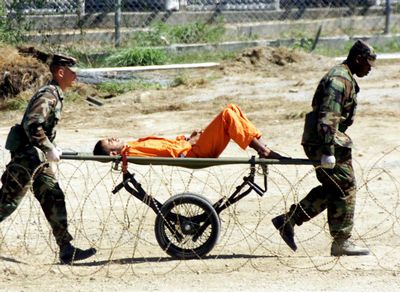
The world cries out in protest against US brutality at Guantanamo, but Congress lies supine and silent.

Dear Senator,

In March of 2004, before the Abu Ghraib scandal broke, I wrote you a letter calling your attention to the abuse of detainees at Guantanamo. I noted that information leaking out from the camp plus reports of attempted suicides coupled with the officially admitted facts and decrypted government double-talk, all pointed to the conclusion that people who had never be shown to be guilty of anything were being institutionally and routinely abused and tortured.

Since then you have said nothing... not even on your web site, not even read into the Congressional Record at 3.45 a.m. The International Red Cross has broken its 100 year tradition of non-comment and has condemned the mistreatment of the Guantanamo detainees; but you have said nothing. The United Nations has called for the closure of this infamous torture center; but you have said nothing. Our own and only ally in this sordid affair has called for the release of the detainees; but you have said nothing. Attorney General Lord Goldsmith has condemned the illegality of the detentions; but you have said nothing. Human Rights Watch, Amnesty International, scores of NGOs, legal organizations and the Holy See itself have cried out against the infamy taking place at Guantanamo; but you and your supine colleagues in Congress have remained silent.

It now turns out that after five long years of degradation, torture and hopelessness three detainees have committed suicide; and, in a shocking statement that bespeaks the moral putrefaction that rots throughout the United States Government, Rear Admiral Harris has dismissed these suicides as “acts of war.” The Government has called them a “PR” move that shows “no regard for life”. The depravity and perversity of these remarks is without rival in the annals of history, except perhaps for the SS guards who may have laughed at Auschwitz prisoners who electrocuted themselves on the barbed wire while trying to escape.

Suicide horrifies because it goes against the most fundamental grain of all living things, which is to live. Suicides are not “playing games” nor are they “attacking” anyone. They are simply and pathetically ending a life that has been filled only with the certainty of pain and despair.

As the Vatican statement reminds us, even criminals and even enemies are human beings that warrant fair and humane treatment. Even more, detainees who have never been charged must less shown to be guilty of anything.

Ignoring these fundamentals of decency, the United States tortures people to suicide all but openly in the global forum. It does so indifferently to the universal outcry against it. It shrugs off the suicides with a moral depravity and lack of humanity that is beyond belief.

When are you and your supine colleagues going to show some impulse other than craven ambition and political cowardice? When will you recover a sense of shame? When will rise up and speak out against the depravity of this Administration and the culture of thuggery that has seized Washington?

©WCG, 2006
.